Category Instructional Design (ID)
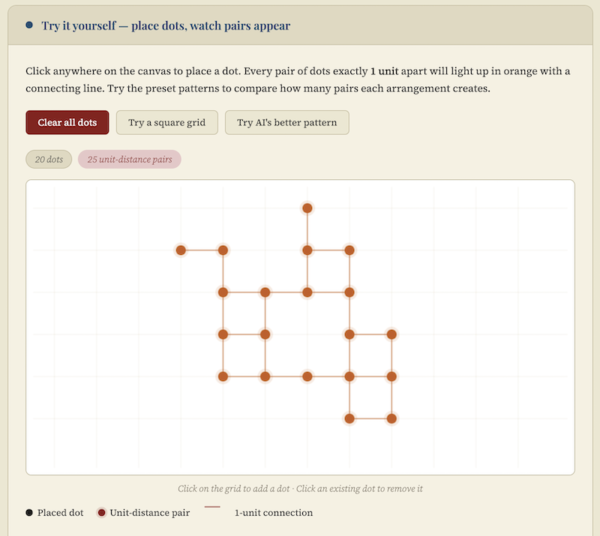
80 years ago, in 1946, Paul Erdős posed a problem. He asked:
If you place N dots anywhere on the same plane, what is the maximum number of those “unit-distance” pairs you can create?
OpenAI’s AI solves the problem in a new, creative way. And then Anthropic’s AI Claude explains the problem by simplifying it and building an interactive tool to support it – both worked without human intervention.
We are living in the most interesting era in all of human history.

Late in applying for the Jan-March session? Don’t worry. We’ll process your application for the April-June session.
If you are thinking of applying for the April-June session, send in your application soon. We have opened registrations, and will be accepting 6 participants only!
Meanwhile, you can get the book to refresh your ID knowledge or level up.
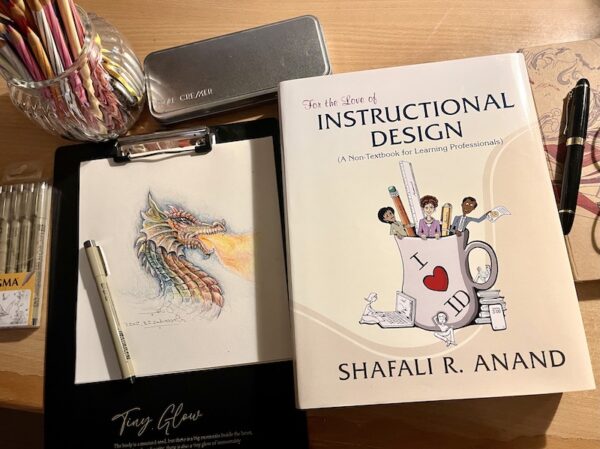
I did a color-pencil drawing of a dragon (or, to be more precise, a dragon’s head). Nothing to brag about, really, except that I had to beat a severe case of demotivation to pick up my pencils.
In this LinkedIn post, I talked about the reason why an artist puts in a lifetime of hard work to acquire the ability to create the exact image of something that they have in their mind.
And if we understand that, we’d understand why instructional design, too, is art.

We, instructional designers, have a lot to learn from fiction. As kids, most of us were taught to shun fiction as a useless hobby/pursuit, and while I am not totally against the argument, I believe that, as adults who work in the field of instructional design, we would do well to read some fiction.
In this post, we’ll see how some important principles of ID (such as the schema theory and the ARCS model) are reflected in fiction.

“For the Love of Instructional Design – The Non-Textbook for Learning Professionals” is here.
Thank you for inspiring me to write it. If it hadn’t been for your exasperated looks, your constant remonstrations, and your perpetual support, I might not have had the patience to spend three years putting this book together. Now, it’s in your hands.
Once again, thank you 🙂

We live in strange times. As human-written content continues to disappear from the Internet (Almost three-fourths of the web pages now have AI-generated content), when I write posts without AI-assistance, I feel rather chuffed.
Anyway, here are five posts that I like quite a bit. This list is somewhat eclectic in nature – but I heartily recommend the xAPI post to all experienced IDs, the creativity post to the perfectionists, the ghosting post to the ghosters and the ghostees, the AI workslop post to those who open their inboxes in the morning and feel a churning in their stomachs, and finally…the LLM’s announcement post to everyone who’s thinking that this is the end of the AI race.
Enjoy reading!

Fink’s Taxonomy of Significant Learning dissolves the distinction among the learning domains and presents learning as the sum of six dimensions, which pan across the learning domains. This post explains the dimensions and emphasizes that regardless of the principles/concepts/models you use, instructional design helps you create effective and holistic learning experiences.

Fourteen links that discuss several key instructional design concepts such as Bloom’s and Krathwohl’s Taxonomies, Merrill’s First Principles, John Sweller’s Cognitive Load theory, Miller’ rule, the ARCS model, constructivism, novice vs, expert, learning objectives, action verbs, audience analysis, and more.

Watch Li’l Bit dancing to celebrate the new session of the IDCDT-AIM Online Course and the introduction of the AI module.

Men and women react differently to the recession. Men stop buying underwear; women start buying lipstick. The question is – do they learn differently, too? Are gender-based cognitive differences real? What difference does it make to the instructional designers creating content for the adult learners?