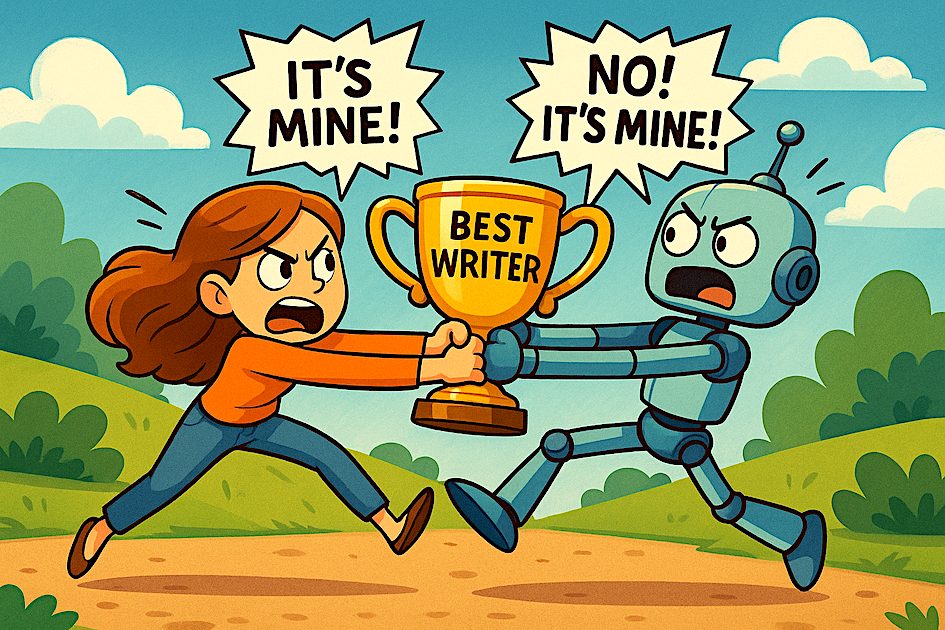
I read somewhere that AI will only replace those writers who refuse to work with AI.
“Work with AI” is a vague statement. One can do a zillion things with AI (including, as I understand, falling in love with it.) What exactly does “working with AI’ mean?
I “work” with AI but I don’t let it write for me.
As you probably know, I “work with AI” in the same vague sense in which that confusing statement is often made. I use AI for creating graphics, building eLearning interactions, researching, and a ton of other stuff. I know that if I asked it to write for me, it would spring up metaphors that would make me swoon. However, I resist all its attempts to write for me, and I know exactly why I do it.
Writing helps me think, and I don’t want AI thinking for me.
Writing, for me, is the tactical parallel of thinking. For as long as I can remember, I’ve thought with a pencil poised over a piece of paper, or with my cursor palpitating over a blank page. The pencil or the cursor open a door for the thoughts to come dancing in. The words then become connections between memories of random events, unfurling a story or a solution – original due to the circumstances of its birth.
So, when I bare my teeth and snarl at AI’s attempts to write for me, I’m merely trying to protect my ability to think. And I am not alone in this quest. Several other writers are holding on to their writing, trying to keep their voice unique and original because they realize that the act of writing, of placing one word in front of the other, is an act of thinking.
I can’t call AI-written content mine.
And then there’s another reason. I can’t call myself an author or even a co-author of a piece written by AI.
Hold on a sec.
Let me see what Google has to say about this issue.
Ah! I am back. Guess what?
While Google’s AI tool leaps to answer any question that you may have, when I ask it “Is is ok to let AI write for you?” it falls curiously silent. However, a beautifully-written, well-reasoned article on Medium pops up. “Did You Really Write That? Why Writers Should Disclose AI Use” by Jim Edgar, explains why we cannot call AI-written and Human-edited content our own. He argues as follows.
If I gave a human writer some ideas and they wrote an article or book based on those ideas, it wouldn’t be ethical for me to claim I wrote the piece or crafted/created the piece. Someone else created the prose and used their writing voice to write it. It’s their creation, not mine.
What a beautiful analogy! What we won’t do with another human, we do with AI. We don’t dig deep into AI’s own learning processes, or we’d be shocked to discover that AI has sharpened its teeth on all sorts of copyrighted material, which we wouldn’t dare to use without crediting the source. And when we do throw an idea at AI, ask it to write, and then call that content our own – we are signing our name under something that was never ours.
You see, there are two reasons why I won’t let AI write for me. One: to save my ability to think, analyze, synthesize, and create something ground up. Two: What Jim Edgar says. If AI used its voice to write something, it’s AI’s creation, not mine.
It’s true that I seek out non-AI writers. I also believe that some of the writing will inevitably be taken over by AI, and I don’t see any harm in it. For almost a whole decade (2010 to 2020), Internet had become a cesspool of badly written, shoddily copied content. I am glad that era is over. However, I wouldn’t want us to hand over our most precious ability – the ability to think – to AI.





1 Pingback