What Exactly is “Responsible Use of AI”?
Here’s a quick and simple definition to get you started.
Responsible use of AI can be best summarized as using AI to do the right task, at the right time, in the right measure, without letting it erode our own ability to think and create.
Responsible use is a term that’s losing its meaning in this stampede of AI-generated content. Human-written content is now being read mostly by Chinese scrape-bots. Humans, on the other hand, are either not writing content or using AI to write it. All that is fine for everyone who doesn’t care two hoots about destroying their own ability to think, but all those who want to stay smart and intelligent must reflect upon their AI usage and pull the brakes on anything that’s slowing their brains down.
As I read news articles and posts about how teachers are struggling to get their learners to complete assignments without using AI, and how some discerning individuals are choosing to use their own mental faculties over AI, I feel optimistic. However, being in the currently unenviable position that I am, I also come across individuals who don’t engage in meta-cognition at all. These individuals with great potential are oblivious to the damage that their indiscriminate use of AI could inflict upon their brains.
Note: Meta-cognition is the act of thinking and reflecting upon our own mental processes.
For this, remember the following two basic rules:
Rule 1: Learning requires that we 1. commit errors and 2. correct them.
Rule 2: Creativity flourishes when the fear of imperfection vanishes.
So, if we don’t allow ourselves to commit errors and correct them, 1. we won’t learn, and 2. the fear of imperfection will become permanent. Eventually, creativity, the most important attribute that future employers will be looking for, will disappear.
The assumption that creativity can flourish in the absence of the mind’s ability to make connections is absurd.
RAD: The Three Baskets of AI
This brings me to RAD – a quick and easy framework to help you stay smart while using AI. In short, RAD is a framework that’s extremely simple to recall and use. Simply put, RAD helps you sort your cognitive tasks into three baskets. AI helps you carry the first two baskets, and you carry the third yourself. In fact, you fight tooth-and-nail to keep the right of carrying the third basket.
Here are the three baskets.
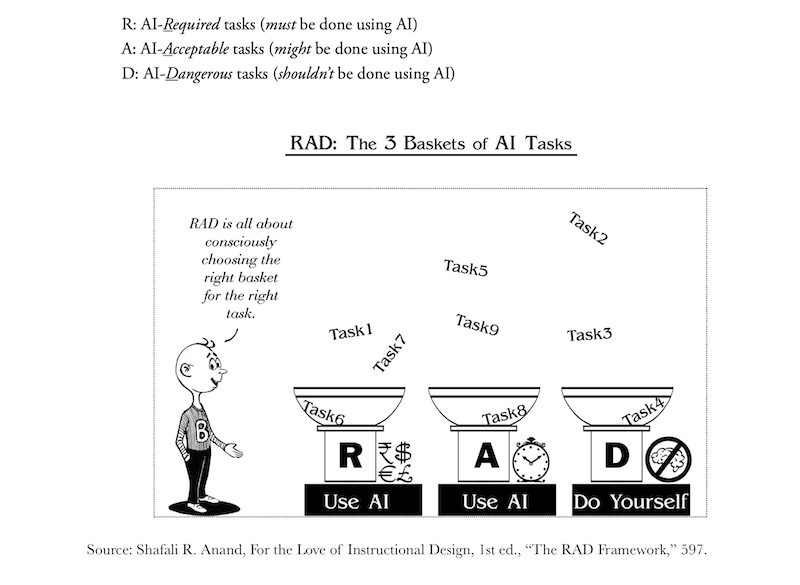
R: Tasks that Require AI (An example of such a task is: Your employer has asked you to use AI for generating LinkedIn posts in bulk, or to build a question bank for a project. Since this task requires that you use AI or become slower/irrelevant etc., you don’t really have a choice in the matter.)
A: Tasks for which AI use is Acceptable (An example of such a task is: Using the map application to find our way out, anything that can save us precious minutes and hours that we can spend doing more fulfilling activities.)
D: Tasks that make the use of AI Dangerous for you (An example of such a task is: Using AI to complete your assignments or write poetry/stories in your stead. These activities help you learn/hone your creativity. Don’t damage your mind for nothing…or in fact, for doing something that you are doing for passion/pleasure.)
This task division is done by each of us, for ourselves, in our individual capacity. We decide the basket into which we must toss a task, because in a democratic world, we must be free to make our choices. And yet, as learning enablers, it falls upon us, the instructional designers, trainers, and teachers, to guide our learners in the right direction.
I hope that this post will help steer your thoughts in the right direction 🙂
Here’s another image (a photograph of the RAD baskets from “For the Love of Instructional Design”)
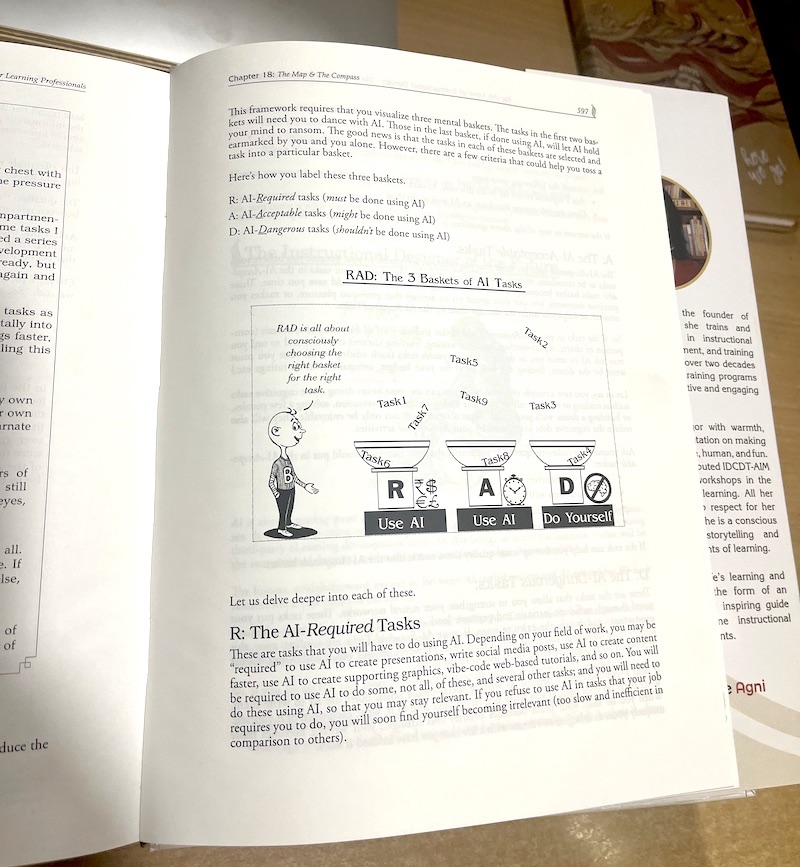
The last chapter of this book (Chapter 18) discusses AI, and one of the topics covered is RAD.
If you want to learn instructional design or refresh your understanding of it, with a strong focus on its application in ILTs/VILTs and eLearning, you may want to check out “For the Love of Instructional Design” on Amazon.





Leave a Reply