80 years ago, in 1946, Paul Erdős posed a problem. He asked:
If you place N dots anywhere on the same plane, what is the maximum number of those “unit-distance” pairs you can create?
The question is deceptively simple, and since then, mathematicians have been trying to solve it using a square grid. Oddly, despite our creativity, we never thought of any other construct than a square grid. But then, AI (specifically OpenAI) came along and reset the board. I came up with fresh constructs that resulted in a far higher number of unit-distance pairs than we were able to come up with through the square construct.
This post is NOT about Erdős’s unit distance problem.
It’s also NOT about AI solving the problem with such flair.
This post is about how Claude answered me.
Here’s the question I put to Claude.
Please explain the Erdos planar unit distance problem to me as if you were explaining it to a 10-year-old.
Claude’s reply?
Well, here it is:
https://www.creativeagni.com/ai-elearning-development/erdos-planar-unit-distance-problem-simplified/erdos-mathematical-problem-solved-by-ai.htm
This is the exact reply that Claude came up with. I just asked it to give it to me in the form of an html page so that I could put it on my site.
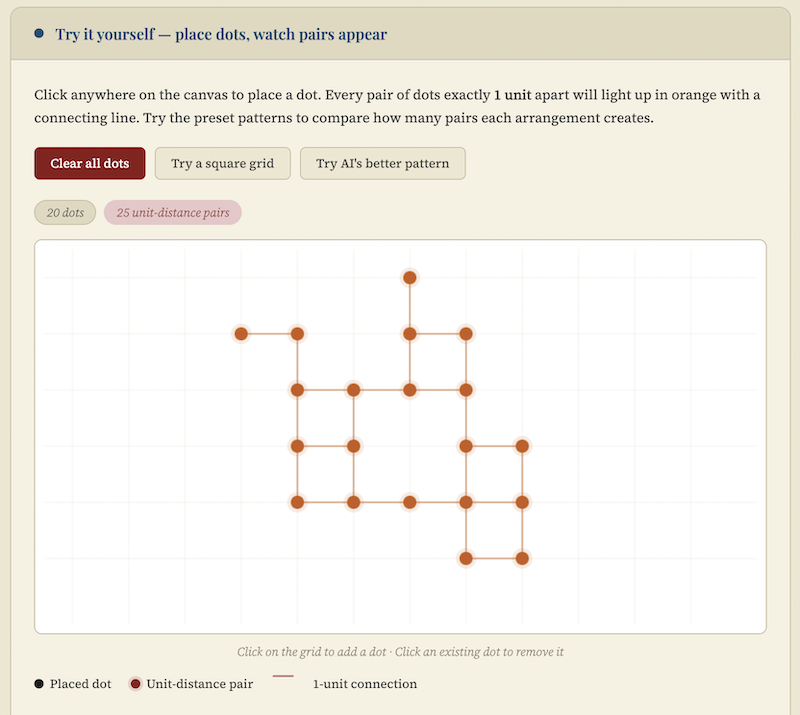
In a nutshell, Claude:
1. Determined a 10-year-old’s level of understanding.
2. Decided that a child would understand the problem better if it were presented visually and kinesthetically.
3. Designed and developed a tab-interactive that shows how AI’s response was different, and how it resulted in a higher number of unit-pairs; it would become easy for a 10-year-old to understand.
4. Divided the content into three parts.
a. The first part introduced the problem and explained it.
b. The second part allowed experimentation and practice.
c. The third part concluded by explaining how AI’s solution turned out to be better.
What did I do?
Honestly? Other than typing, “Please explain the Erdos planar unit distance problem to me as if you were explaining it to a 10-year-old,” I did NOTHING. Claude handled everything autonomously, and I didn’t even ask him(it) to step into the role of an instructional designer.
AI is learning. And it’s learning fast.
We need to remind ourselves that we aren’t in a race with AI. We are in a race with ourselves. And the race is about two things…and two things only.
1. Know your instructional design, stay creative, and don’t let anything impact your critical thinking abilities.
2. Keep a watch on AI’s rapidly evolving capabilities.
For point 1, do check out “For the Love of Instructional Design” at: https://www.amazon.in/dp/933437098X





Leave a Reply